Tim Trainum Properties
"Delivering a Preferred Experience in Real Estate!"
REALTOR®, VA License #0225235004



Key Local Market Info!
 RSS Feed
RSS Feed
- 2026 | 10 Posts
- 2025 | 12 Posts
- 2024 | 12 Posts
- 2023 | 12 Posts
- 2022 | 13 Posts
- 2021 | 13 Posts
- 2020 | 12 Posts
- 2019 | 15 Posts
- 2018 | 15 Posts
Subscribe and receive email notifications of new blog posts.
July
7
7
Who Determines the Selling Price of Your Home in Northern Virginia?
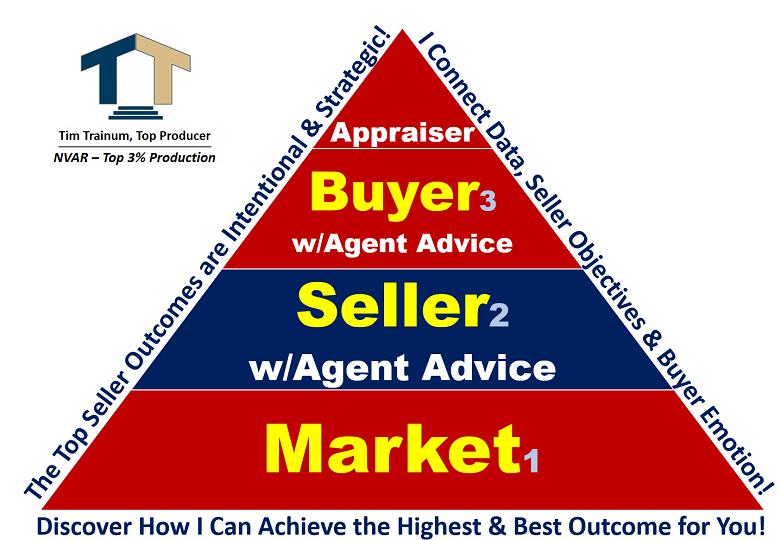
The Easy Answer is the Seller, but it's Much More Complicated
It's your home, your asset, you determine the price, right? While technically true, there are actually six (6) elements that help determine the selling price of your home, one by one. Each part is a stepping stone to the next working to verify price until you reach the ultimate objective - settlement.
1. Market - The factors that most control the price of your home are determined by the market and economic conditions. Real estate is the only market open 24 hours a day, 365 days a year constantly providing data to buyers and sellers. The market is the final arbiter of price just like with any product. It's a function of elements like supply and demand, absorption rates, competition, the economy, jobs, consumer sentiment, business sentiment, interest rates and access to capital (loans). If you don't believe the market is the driving force behind the price of your home, then just consider the potential impact on prices if access to mortgage loans became difficult or consumer sentiment chilled. Need other examples? Consider 2002-07 when home prices in Northern Virginia were increasing 15% year over year to an apex increase of 26% in 2006. Likewise, many new construction builders can experience price swings of $10,000's from beginning to end of a new development. In each example, nothing changed in housing product, only the supply and demand element of the market changed.
2 & 3. Seller (with help from the Listing Agent) - The seller controls price and condition of the home with guidance from the Listing Agent. The Listing Agent is the real estate professional who helps clients buy and sell homes every day, regularly working with appraisers and should be the one best equipped to understand the real-time selling texture of the market. After a thorough analysis of the market data most relevant to a seller's home and neighborhood, the Listing Agent should produce a complete evaluation that forms the basis for expert guidance and recommendations helping the seller make the best decision possible on price. The best agents help sellers to best position the home, stacking the deck in their favor. In fact, a very beneficial exercise I perform with my sellers is closely monitoring neighborhood activity with them during our pre-listing work. We discuss the movement of every home that comes on the market. We physically preview homes comparing and contrasting against their home. We watch the homes either quickly move to a sale, languish or even fail to sell. We evaluate why they moved the way they did.
4 & 5. Buyer (with help from the Buyer Agent) - After the seller and Listing Agent have done their job to prepare the home and present it to market, then comes the crucial part. While the seller controls "price", the buyer controls "value" with the guidance of their agent. If a buyer determines the home to be a compelling value at the condition and listing price offered, then great things will happen. The most skilled Listing Agents create an environment of competition that will direct buyers to the seller's highest and best outcome. Often, this can mean bidding up price and bidding down seller contingency risk. If the home does not present compelling value to buyers, then it will be at risk of languishing and becoming a stale listing. The listing price will drop, contingency risk will go up in order to sell. Carrying costs can accumulate. Sellers can even face the possibility of a failed sale altogether.
6. Appraiser - The seller and buyer have a ratified contract with agreement on the sales price. The contract is in underwriting with the lender who is working to fund the mortgage loan. The last step is the lender ordering an appraisal to verify the price agreed to between the seller and buyer correctly represents market. The appraisal is an unbiased estimate of value of the home as supported by recently sold comparables. The opinion of value determined by the appraiser must be no less than the sales price agreed to in the contract or the loan cannot be approved. This is one of the most vital parts of the process for sellers, which is why I prefer meeting with the appraiser to discuss the estimate of value. I do this for several reasons, but chief among them is to specifically walk the property to thoroughly discuss the home. I like to point out any improvements, specific sales comps, multiple offers if we received them and discuss specific sub-market data that could be useful to the appraiser. My objective is to take full advantage of this last opportunity to secure the selling price.
Arriving at the Highest & Best Selling Price is Strategic & Intentional
Achieving the most beneficial seller outcome never just happens by coincidence. It's an organized and intentional agent-driven process. Sellers are shocked to learn over 10,000 homes in Northern Virginia don't sell each year. These listings either expire (fail to sell prior to the end of the listing agreement), are canceled by the seller, or the seller decides to withdraw the listing from the MLS. In each case, this is a failed sale for the seller, resulting in a terrible outcome. Listings with an organized, well-executed selling plan do not fail to sell.
"Aside from condition, the largest impediment to selling a home is mispricing and causing excessive time on market. A home only has one opportunity to be new to market and a seller has limited time to capitalize on a buyer's most vulnerable psychological bias – panic and fear of missing out to a competing buyer. Setting condition, price and agent marketing must be strategically planned and it's the key to sellers maximizing gains and minimizing risk." – Tim Trainum

Tim Trainum Properties
Office: (571) 386-1075 Cell: (703) 568-6750 Email Me
- 43777 Central Station Drive
- Suite 390
- Ashburn, VA 20147
Office: (571) 386-1075 Cell: (703) 568-6750 Email Me



Privacy Policy / DMCA Notice / ADA Accessibility


This site is hosted, designed and copyright
© 1994 - 2026 by
Delta Media Group, Inc. -- Patent Pending --